From low participation and busy schedules to leadership support and the power of small daily practices, how can organisations create workplace wellbeing programs that people actually use?
“We've created the wellbeing program. So why isn't anyone turning up?”
If I had a dollar for every HR or wellbeing manager who has said something along these lines over the years, I'd have a rather healthy savings account!
"We surveyed our employees. We asked what they wanted. We spent months planning our wellbeing program, put together a fantastic calendar of activities, promoted it internally... and yet hardly anyone turns up."
Does this sound familiar?
It's a frustration I've heard repeatedly during my years working with organisations across Australia.
And it's understandable. People & Culture teams invest considerable time, thought and energy into supporting employee wellbeing. They genuinely want to make a difference. But there's often a disconnect between what employees say they want and what they're actually able to participate in.
The issue isn't necessarily the quality of the wellbeing program. Sometimes it's everything happening around it.
As we look towards 2027, I believe one of our biggest opportunities is to stop focusing solely on what wellbeing activities we offer and start thinking more about how we make wellbeing part of everyday working life.
The workplace wellbeing landscape is changing
When I established Corporate Yoga Australia in 2014, workplace wellbeing was often centred around the occasional yoga class, a complimentary fruit bowl in the office kitchen and maybe a bonus health awareness day.
These initiatives helped open the conversation, but workplace wellbeing has evolved considerably.
Today, we're talking about psychological safety, healthy leadership, workload management, employee connection, flexibility and the importance of creating working environments where people can thrive.
Recent research reinforces why this broader approach matters.
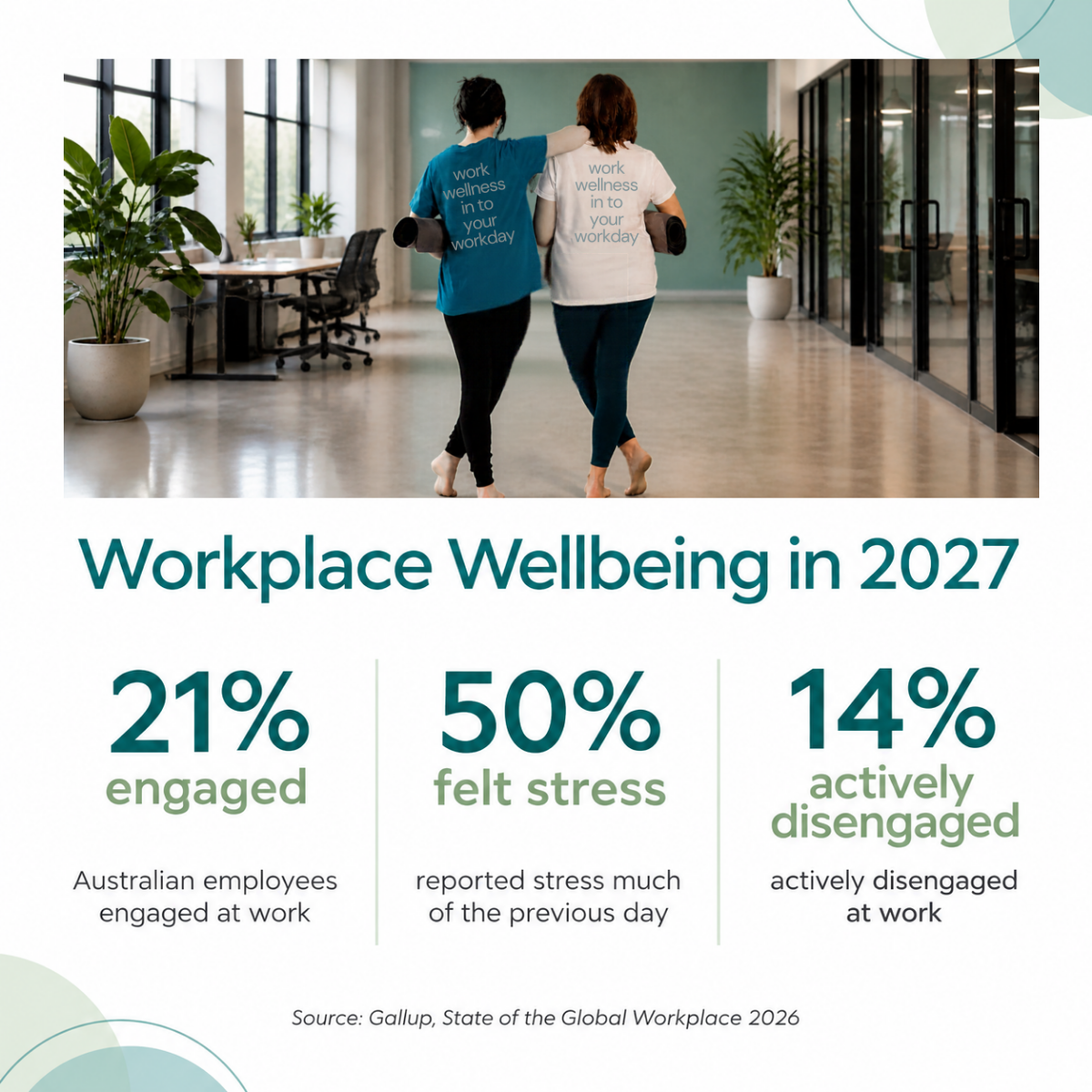
Gallup's State of the Global Workplace 2026 report found that just 21% of Australian employees were classified as engaged at work, while 50% reported experiencing stress for much of the previous day.
Importantly, employee engagement and participation in wellbeing activities are different measures. But together with wider research on employee health, these findings encourage us to consider how people experience their working lives.
Workplace wellbeing needs to move beyond being another activity on the calendar. It needs to become part of how we work.
Why employees don't participate, even if they say they want to
Here's something I've noticed over the years. Employees often express genuine enthusiasm when asked whether they'd like yoga, Pilates, mindfulness or other wellbeing activities introduced into their workplace.
Yet when the program begins, attendance doesn't always reflect that enthusiasm.
Why?
There are several possible reasons.
1. They simply don't have the time.
Employees may love the idea of a lunchtime yoga class, but when their calendars are packed with meetings, deadlines and competing responsibilities, taking time away from their desks can feel difficult.
In a 2025 survey of US workplace wellness initiatives, 33% of responding organisations identified employees' difficulty finding time to participate as a barrier.
Research has also identified scheduling, accessibility and perceived relevance as important influences on participation.
2. They don't feel they have permission to step away.
A wellbeing program might be enthusiastically promoted by HR, but if employees feel that attending will be frowned upon by their manager, participation can suffer.
If a manager continues scheduling meetings over the wellbeing session or never takes a break themselves, what message does that send?
Employees often take their cues from the people around them.
3. The activity doesn't feel relevant or accessible.
Not everyone wants to join their colleagues for a lunchtime yoga class, and that's perfectly okay.
Some employees might prefer to practise yoga online, join a short stretching session or listen to a guided meditation.
Others may enjoy trying a healthy recipe, taking a mindful walk around the block or simply stepping away from their desk for a few minutes of fresh air.
We all have different ways of looking after our wellbeing. While some people thrive on group activities and the opportunity to connect with colleagues, others prefer to practise independently, in their own time and at their own pace.
And of course, different roles, working arrangements, abilities and personal preferences all influence how people engage.
A well-designed workplace wellbeing program recognises that there's no one-size-fits-all approach.
Offering a variety of activities, formats and ways to participate gives employees more choice and makes it easier to build healthy habits that suit their individual needs and working day.
4. The program loses momentum.
There's often excitement when a new wellbeing initiative launches.
But after a few weeks, attendance can decline.
Without ongoing communication, visible support and opportunities to build regular routines, even a popular program can fade into the background.
The solution isn't necessarily to keep introducing more activities.
Sometimes we need to make the existing ones easier to access, more relevant and more consistent.
The missing ingredient: Management buy-in
One thing I feel particularly strongly about is the importance of having management genuinely behind a wellbeing initiative.
Not simply approving the budget. Actually supporting participation.
Research into workplace wellbeing participation has identified leadership support and organisational culture as important factors in whether employees engage with programs.
Imagine two workplaces.
In the first, HR organises a weekly wellbeing session, but employees are expected to fit it around their normal workload, managers continue scheduling meetings and there's little encouragement to attend.
In the second, managers actively support participation, protect time where practical and occasionally join in themselves.
Which environment is more likely to make employees feel comfortable taking part?
Leadership support doesn't mean everyone needs to become a yoga enthusiast.
It means recognising that employee wellbeing deserves space within the working day.
And importantly, organisations must also address the workplace conditions that contribute to stress. Yoga or meditation cannot compensate for excessive workloads, poor leadership or unmanaged psychosocial risks.
The power of workplace wellbeing champions
Another approach I love is developing a network of wellbeing champions across an organisation.
These are people who genuinely enjoy encouraging others to get involved.
They might be employees from different departments, locations or levels of seniority who help bring energy and visibility to wellbeing initiatives.
Rather than relying solely on one HR manager to drive participation, wellbeing champions can help:
Share upcoming activities with their teams.
Encourage colleagues to try something new.
Gather informal feedback about what people enjoy.
Suggest improvements to timing, accessibility and activities.
Help normalise taking breaks and participating in wellbeing initiatives.
They don't need to become wellbeing experts.
Their role is to help create connection and a sense of shared ownership.
Of course, champions need support from leadership and realistic expectations. They shouldn't be responsible for solving workplace stress or carrying the wellbeing program on top of an already demanding workload.
But with the right structure, they can become valuable advocates for a healthier workplace culture.
Small moments, repeated often: Building healthy habits that stick
One of the biggest shifts I'd love to see in workplace wellbeing is moving away from thinking that every activity needs to be a major event.
Sometimes, the simplest practices are the easiest to integrate into working life.
A three-minute movement break.
A few mindful breaths before a meeting.
Standing up and stretching after a long period of sitting.
A short guided meditation during the afternoon.
Or a weekly movement session that becomes a familiar part of the team's routine.
The science of habit formation offers some useful insights here.
A systematic review published in Healthcare examined 20 studies involving 2,601 participants and found that forming health-related habits generally takes longer than the often-quoted 21 days.
In studies reporting median times, habit formation took approximately 59–66 days, although there was considerable variation between individuals and behaviours.
Researchers also identified the importance of repetition, consistent contexts, enjoyment and personal choice.
The lesson for workplace wellbeing?
Rather than expecting a single workshop to change behaviour, consider how small practices can be repeated regularly.
For example:
A one-minute breathing practice before a recurring team meeting.
A short stretch break after the morning coffee.
A five-minute mindful pause during the afternoon.
A weekly yoga or Pilates class that employees can build into their routine.
These aren't guaranteed to become habits simply because they're short. But making activities accessible, enjoyable and easy to repeat can help create more opportunities for consistency where long term behaviour change can begin.
Making wellbeing accessible beyond scheduled classes
Regular workplace classes and facilitated sessions are wonderful opportunities for connection, movement and learning.
But they don't suit every employee or every working schedule.
What happens to the team member working remotely?
The employee who can't step away at lunchtime?
The person who would love to practise mindfulness but feels uncomfortable joining a group?
Or the employee who needs a five-minute reset rather than a full class?
This is one of the reasons we're excited about the next chapter for Corporate Yoga Australia.
In February 2027, we'll be formally launching our Corporate Yoga Australia Wellbeing Studio, extending our workplace wellbeing offering through accessible online practices.
Built around three simple ideas - Pause, Move and Learn — the Studio is being developed to help people access practical wellbeing support throughout their day.
Short movement breaks, guided breathing, mindfulness practices and wellbeing education will provide flexible ways for employees to engage, alongside facilitated workplace programs.
The intention is to make wellbeing more accessible, wherever and whenever people have the opportunity to participate.
Because sometimes a short practice that an employee can realistically fit into their day is more useful than a longer session they never manage to attend.
Five questions to ask when planning your 2027 wellbeing program
Before adding more activities to next year's wellbeing calendar, I'd encourage organisations to consider five questions.
1. Do employees genuinely have the time and permission to participate?
Are activities scheduled realistically? Do managers support attendance? Are workloads considered?
2. Are leaders visibly supporting wellbeing?
Does leadership demonstrate the behaviours the organisation is encouraging?
3. Could wellbeing champions help build participation?
Would having advocates across different teams help improve communication and encourage involvement?
4. Are there different ways for employees to engage?
Could you combine regular classes, short workplace practices, online resources and different session formats to make wellbeing more accessible?
5. Are we measuring more than attendance?
Participation matters, but so does feedback, accessibility, employee experience and whether the program is achieving its intended goals.
Low attendance can provide valuable insights. It may tell us that something needs to change, whether that's the format, timing, communication or the broader workplace environment.
But I also believe some of the most meaningful benefits of workplace wellbeing are the hardest to measure.
It's the breathing technique that helps someone stay calm during a stressful day.
The mindfulness practice that allows a manager to pause before reacting, approaching a difficult conversation with greater patience, empathy and clarity.
The movement break that helps someone return to their desk feeling refreshed and more focused.
Or the few minutes of stillness that give someone the space to respond thoughtfully rather than react emotionally.
These small moments may never appear in an attendance report or a spreadsheet, but they can make a real difference to how people experience their day, interact with colleagues and lead others.
Not everything that matters can be easily measured, and not everything we measure tells the whole story.
While it's important to evaluate participation and outcomes, we should also create opportunities for employees to share how wellbeing practices are supporting them in their everyday working lives. Sometimes the true value of a wellbeing program isn't simply how many people attended a session, it's what they take away and how they carry it into the rest of their day.
From a wellbeing calendar to a culture of wellbeing
As we look towards 2027, perhaps the next step isn't simply offering more yoga classes, workshops or wellbeing events.
It's making sure the opportunities we create are accessible, meaningful and something employees feel genuinely encouraged to use.
Ultimately, the question shouldn't just be:
"What wellbeing activities should we offer?"
But rather:
"How can we create a workplace where healthy habits become a natural part of the way we work?"
Bringing wellbeing into your workplace
At Corporate Yoga Australia, we've spent over a decade helping organisations bring practical wellbeing experiences into the working day.
Through our network of experienced teachers and facilitators across Australia, we offer everything from regular workplace yoga, Pilates, meditation and mindfulness classes to breathwork, lunch-and-learn workshops, conference activations and tailored wellbeing programs.
Every employee is different, and we believe wellbeing programs should reflect that.
Whether it's a weekly class that brings colleagues together, a short movement break during a busy day or flexible online practices through our upcoming Wellbeing Studio, our focus is on making wellbeing accessible, engaging and relevant to the people participating.
If you're planning your 2027 wellbeing calendar or looking for ways to improve participation in an existing program, we'd love to help.
Explore our workplace wellbeing programs, discover our upcoming Online Wellbeing Studio or book a complimentary Studio walkthrough to discuss what might work for your team.
Work Wellness into Your Workday.
Research and references
Gallup (2026). State of the Global Workplace: Australia Country-Level Data. https://www.gallup.com/workplace/704474/state-global-workplace-australia-country-level-data.aspx
International Foundation of Employee Benefit Plans (2025). Workplace Wellness and Financial Education Survey Report. https://www.ifebp.org/detail-pages/resource/survey/workplace-wellness-and-financial-education--2025-survey-report-%28u.s.-and-canada%29
Deloitte (2025). Well-being at Work Survey. https://www.deloitte.com/global/en/insights/topics/talent/2025-well-being-at-work.html
Sherman, B. W., et al. (2024). Why Don't Employees Participate in Well-being Programs? A Research-Informed Systems-Based Model. https://pubmed.ncbi.nlm.nih.gov/37964600/
Time to Form a Habit: A Systematic Review and Meta-Analysis of Health Behaviour Habit Formation and Its Determinants (2024). https://pubmed.ncbi.nlm.nih.gov/39685110/
UC Berkeley, Interdisciplinary Center for Healthy Workplaces. Increasing Participation Rates in Wellness Programs for Small and Medium Organizations. https://healthyworkplaces.berkeley.edu/publications/increasing-participation-rates-wellness-programs-small-and-medium-organizations